

Have you ever found yourself trapped in a full-blown debate with your own brain at 2:00 AM?
Maybe your brain served up a sudden "What if?" about a decision you made yesterday, a worst-case scenario about the future, or an intrusive image that felt instantly unsettling. Within seconds, you were down the rabbit hole—analyzing, checking, searching for reassurance, or trying to mentally "solve" a feeling that didn't actually come with a clear solution.
If you live with OCD, Generalized Anxiety, or ADHD, this mental ping-pong match is exhausting. It eats up precious time, steals your energy, and leaves you feeling completely drained.
When intrusive thoughts or worry loops hijack our focus, standard advice often tells us to "reframe" the thought or "think positive." But for a neurodivergent or anxious brain, trying to debate a worry is like throwing gasoline on a fire—it gives the thought attention, authority, and power.
This is where one of my absolute favorite tools comes in: Non-Engagement Responses.
What Is a Non-Engagement Response?
In therapies like Exposure and Response Prevention (ERP) and Acceptance and Commitment Therapy (ACT), a non-engagement response (NER) is a brief, neutral, matter-of-fact statement used to acknowledge a thought without taking the bait.
Instead of fighting the thought ("That's not true!"), analyzing it ("Why did I think that?"), or performing a compulsion ("Let me Google this for two hours"), a non-engagement response says: "I hear you, but we aren't doing this today."
It’s the mental equivalent of giving a short, polite nod to a noisy stranger on a bus and turning back to your book.
Why It Works for OCD & Anxiety
OCD and anxiety thrive on engagement. When you argue with an intrusive thought or seek reassurance, your brain’s threat system registers that action as proof: "Aha! You're working so hard to fix this, which means this thought must be a genuine emergency!"
By offering a neutral, non-reactive response, you teach your nervous system over time that a thought is just a thought—not a command, an emergency, or a reflection of your character.
The Neurodivergent Twist: Why Non-Engagement Responses Are a Game-Changer for ADHD
While NERs were largely designed for OCD and anxiety exposure, they are an absolute superpower for the ADHD brain. Here’s why:
1. They Save Executive Function
Cognitive restructuring (challenging and replacing thoughts) requires immense executive function—working memory, self-monitoring, and cognitive flexibility. When an ADHD brain is already depleted, forced mental wrestling leads straight to cognitive overload and "brain fog." Non-engagement responses take almost zero processing power.
2. They Break the Hyperfocus Rumination Trap
ADHD brains are wired for novelty and high stimulation, which unfortunately means an anxious thought can pull us into a dopamine-seeking "solving" loop. We hyperfocus on resolving the uncomfortable feeling right now. A non-engagement response acts as a low-friction emergency brake, helping you disengage before hyperfocus locks in.
3. They Bridge Emotional Dysregulation and Action
Rejection Sensitive Dysphoria (RSD) and intense emotional spikes can make thoughts feel instantly overwhelming. NERs give you a gentle middle ground: you don't have to convince yourself everything is okay, nor do you have to spiral. You simply validate the brain's activity and return to the physical world.
What Non-Engagement Responses Sound Like
The secret to a good non-engagement response is tone. It should be neutral, slightly bored, and completely non-defensive.
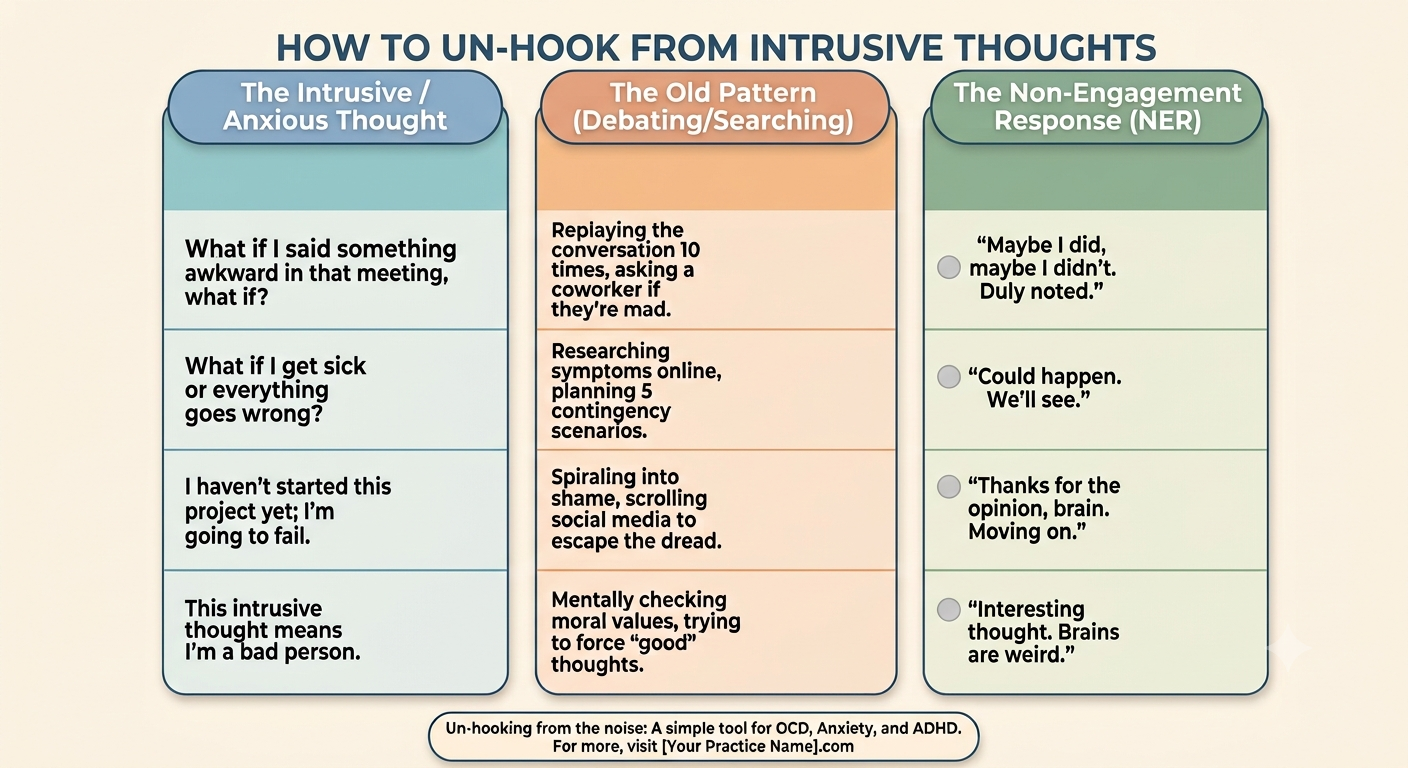
How to Start Practicing (Without Needing Perfection)
Catch the "Hook": Notice the exact moment your brain throws out bait that makes your stomach drop or your mind race.
Choose Your Go-To Phrase: Pick 1 or 2 phrases that feel natural to you ("Maybe, maybe not," "Noted," "Thanks, mind").
Say It and Drop It: State the response (internally or out loud), drop the mental debate, and gently shift your physical body toward whatever you were doing next—washing a dish, walking the dog, or opening a document.
Expect the Discomfort: Acknowledge that your brain might protest at first ("Wait, aren't we going to panic about this?!"). That spike of anxiety is totally normal—let it ride in the background like static on the radio.
You Don't Have to Win the Argument to Find Peace
Living with a brain that produces constant noise, worry, or intrusive thoughts is exhausting. But you don't have to win an argument against your own mind to regain control of your day. By dropping the debate and adopting a non-engagement stance, you preserve your energy for the things that truly matter to you.
